

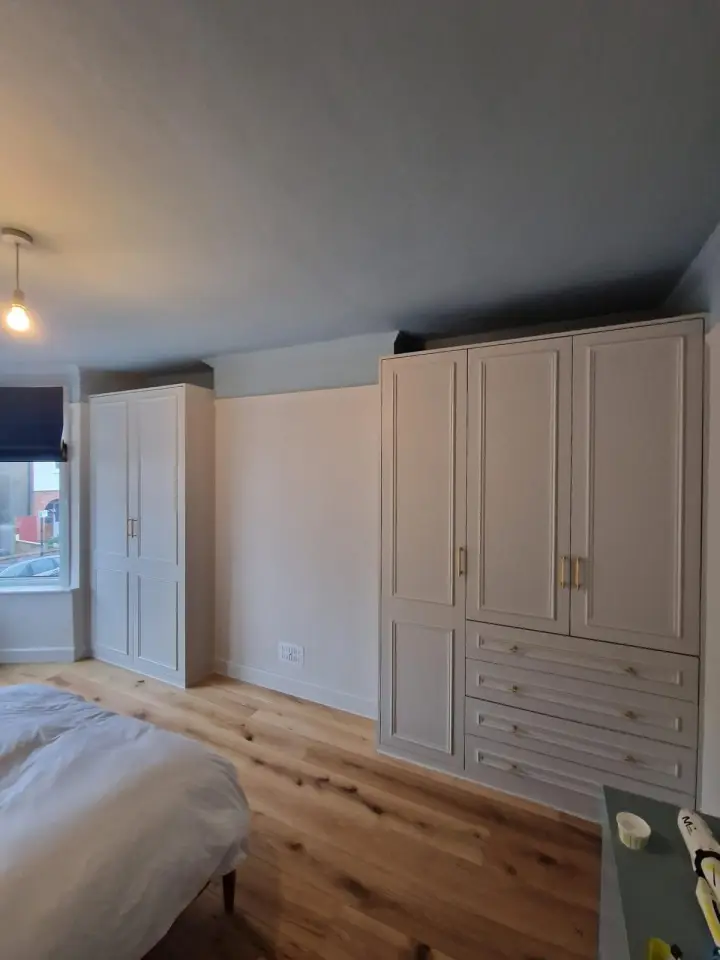
Fitted wardrobes are usually the better choice if you want the most storage from a room, need to work around awkward spaces such as chimney breasts, sloping ceilings or alcoves, and plan to stay in the house. Freestanding wardrobes are better if you rent, expect to move soon, or want furniture you can take with you or rearrange. Below we compare the two on storage, fit, appearance, flexibility and value, so you can decide what suits your room.
What's the difference?
A fitted wardrobe is built into the room, usually running from wall to wall and floor to ceiling, and made to measure for the space. A freestanding wardrobe is a separate piece of furniture that sits against a wall and can be moved. Fitted wardrobes are made by a carpenter or joiner for a specific room; freestanding wardrobes are bought ready-made in standard sizes.
Storage space
Fitted wardrobes use the full height of the room and every centimetre of width, including the gaps that freestanding furniture leaves above, beside and behind it. In a typical London bedroom that extra space adds up. The inside can also be planned around what you actually own: long and short hanging, shelves, drawers, shoe storage and space for bags and bedding.
Freestanding wardrobes come in fixed sizes, so in most rooms there will be some wasted space, and you're limited to the internal layouts on offer.
Fitting awkward spaces
This is where fitted wardrobes really stand out, particularly in older houses. Victorian and Edwardian bedrooms often have chimney breasts, alcoves, uneven walls and floors, and sloping ceilings in loft rooms. Made-to-measure wardrobes can be scribed to fit walls that aren't straight, and designed around chimney breasts and sloping ceilings, so spaces that would otherwise be wasted become useful storage.
Freestanding furniture rarely fits these spaces well. A standard wardrobe in an alcove usually leaves gaps, and a sloping ceiling may mean it doesn't fit at all.
For more ways to use the space either side of a chimney breast, see our alcove unit ideas.
Appearance
Fitted wardrobes look like part of the room. They can be finished to match your walls, doors and skirting, with door styles from simple flat panels to shaker designs, and they can be combined with other joinery, such as alcove units, a dressing table or wall panelling, for a consistent look throughout the house.
A good freestanding wardrobe can be a beautiful piece of furniture in its own right, and some people prefer the look of an antique or statement piece, especially in a large room.
Flexibility
Freestanding wardrobes win on flexibility. You can move them to another room, rearrange the bedroom or take them with you when you move. That makes them the natural choice for renters, who usually can't fix furniture to the walls, and for anyone who expects to move soon.
Fitted wardrobes stay with the house. If you're planning to stay for several years, that's rarely a problem, and well-made fitted storage can appeal to buyers when you do sell.
Cost and value
The cost of either option varies widely depending on size, materials, finishes and internal fittings, so it's worth getting a quote for your room rather than relying on general figures. When comparing, think about what you're getting: a fitted wardrobe gives you more storage from the same space and is built to suit the room, while a freestanding wardrobe can be reused elsewhere. It's also worth considering the time and disruption of installation: freestanding furniture can be delivered and in use the same day, while fitted wardrobes are measured, made and installed.
Materials, doors and fittings
With fitted wardrobes you choose the details. Painted finishes are popular because the wardrobe can be matched to the walls or picked out in a contrasting colour, while timber and wood veneer suit a more natural look. Door styles range from flat, handleless panels for a modern room to shaker-style doors that suit period houses. Mirrored doors can make a small bedroom feel larger.
Inside, think about what will make daily life easier: soft-close hinges and drawers, pull-out shoe racks, trouser rails, double hanging for shirts, and internal lighting that comes on when the door opens. These details are hard to add later, so it's worth deciding on them at the design stage.
Quick comparison
- Most storage from the room: fitted.
- Awkward spaces (alcoves, chimney breasts, slopes): fitted.
- Matches the room and other joinery: fitted.
- Renting or moving soon: freestanding.
- Can be moved or taken with you: freestanding.
- Quickest to get in place: freestanding.
Planning fitted wardrobes
If you decide on fitted wardrobes, a few things help the project go smoothly:
- List what you need to store – long coats and dresses, shirts, folded clothes, shoes, bags and bedding – so the inside can be planned around it.
- Think about doors and access – hinged doors need space to open; sliding doors suit tighter rooms.
- Plan lighting and sockets early – internal lighting is easiest to add before the wardrobe is built, and sockets and switches may need moving.
- Combine with other work – if you're renovating, plan joinery alongside the building work so walls, floors and electrics are ready for it.
Costa Construction makes and fits bespoke carpentry across South London, including fitted wardrobes, alcove units, media walls and panelling. Send us photos of your room on WhatsApp, call 07340042048 or contact us for a quote.